The Credential Breakdown
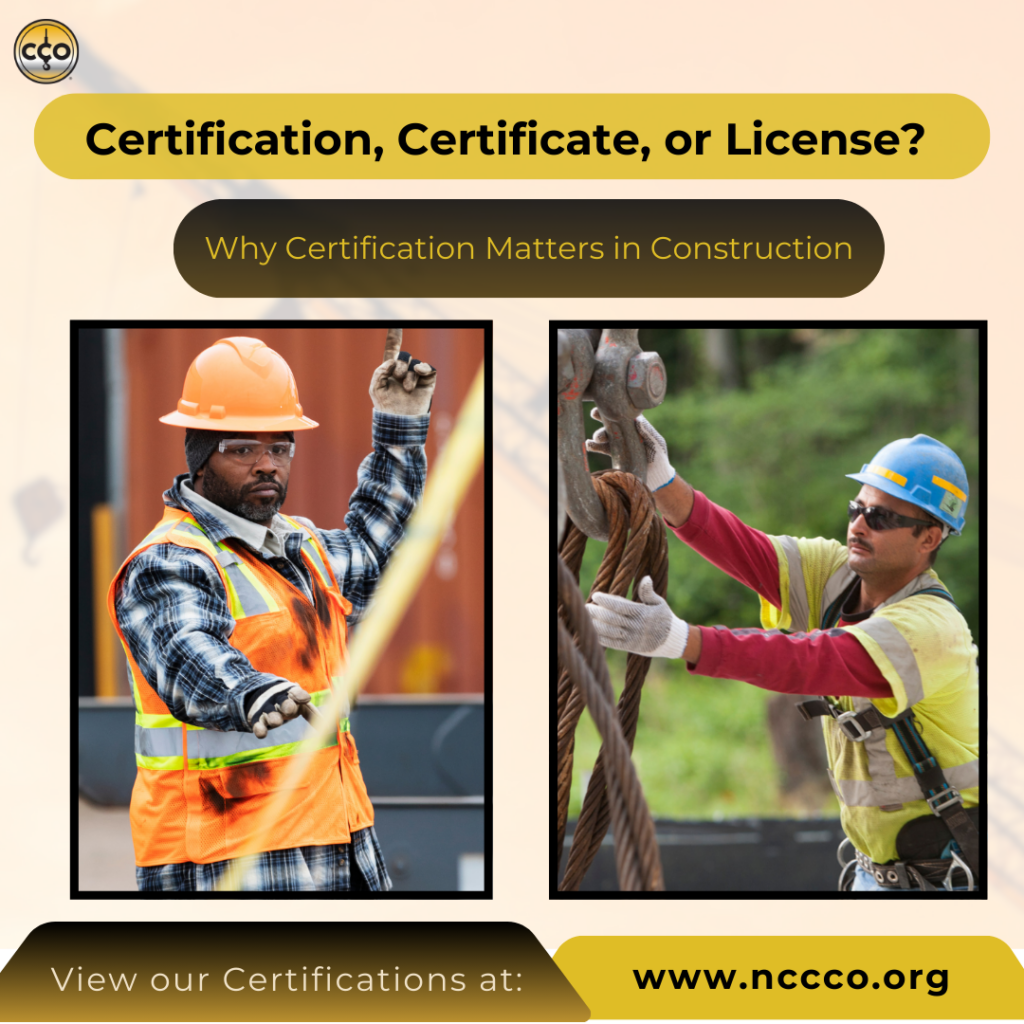
Safety and compliance serve as essential elements in the current construction industry climate. The operation of cranes and signaling along with rigging requires workers to receive proper knowledge followed by evaluation to determine qualification. Employers face the challenge of interpreting OSHA and ASME requirements through a main question:
What’s the difference between certificate, license and certification?
The table below is a comprehensive analysis to help illustrate these distinctions and follows the framework of OSHA-aligned guidelines.

A qualified worker holds the knowledge, skills and abilities required to execute a job safely. However, it is often left up to the employer to determine how this qualification is achieved. Many organizations provide training to their employees under the guise of “certification”. However, certification stands apart because certification is performed by third parties not involved in training. Employers who are training their own employees are actually performing a “certificate” evaluation which doesn’t meet the same requirements as certification.
Due to the confusion between certification and certificates, employers are finding that they are having to defend the qualification of their employees. The absence of standardized testing along with objective benchmarks creates inconsistent qualification determinations that expose organizations to legal and safety risks. Employers who rely exclusively on their internal qualification processes risk legal exposure when accidents happen because they struggle to establish clear proof of worker competency.
Defining Certificates, Licenses and Certification
A certificate is issued by an instructor (internal or external) to students who attend and finish a training course. The certificate of completion document confirms candidate attendance at the training event but does not necessarily show proof of understanding or practical application of received information. Employers need to be aware and able to defend the course and assessment (if any). Further, certificates are not portable from employer to employer. Additionally, certificates can not have an expiration date. For example, the completion of a rigging course results in receiving a certificate but this only means that they successfully attended the course.
A license is awarded by a governmental agency to a candidate that meets legal and regulatory requirements. Licenses may incorporate a certification for assessment purposes, but licenses are about governmental agencies authorization of the individual to perform the work covered by the scope of the license. Licenses can differ from state to state and from locality to locality.
A certification requires an official evaluation conducted by a third-party organization. The certification process defines an exact and uniform standard to aid in identifying competent workers in specific job roles. The process of getting certified resembles obtaining a driver’s license since candidates must pass both knowledge and practical skill assessments through standardized exams. Accredited certification bodies meet an even higher standard by ensuring that the development process of certification exams includes job task analyses, which allows industry professionals to identify real-world scenarios for workers. Accredited certification also include subject matter experts along with psychometricians to create fair, valid and reliable assessments after analyzing the requirements and job-task analysis.
The certification process does not end after one successful completion. After a designated period, certificants must undergo recertification because it is imperative to stay up to date with changing regulations, technological developments, and best practices. In CCO’s case, most certification programs require recertification every 5 years.
Why Certification Matters in Construction
The practice of using internal qualifications or training certificates as substitutes for certification proves dangerous because these methods frequently fail inspections and investigations and lead to legal issues. Certification functions as a legally valid assessment that can assist in proving expertise. When employers have workers who are certified on the job, this means reduced legal liability, improved jobsite safety and greater confidence among workers regarding capabilities and skills. Certification bodies like CCO provide employers with an evidence-based system to help evaluate worker competencies for essential crane operations and load handling procedures.
The construction industry requires thorough training and evaluation because inadequate practices result in jobsite accidents, major expenses and potential shutdowns. CCO Certification is considered the gold standard as it provides organizations with reassurance regarding their operations. For more information about the certification process, visit: https://ccocert.org/en/testing-overview/